
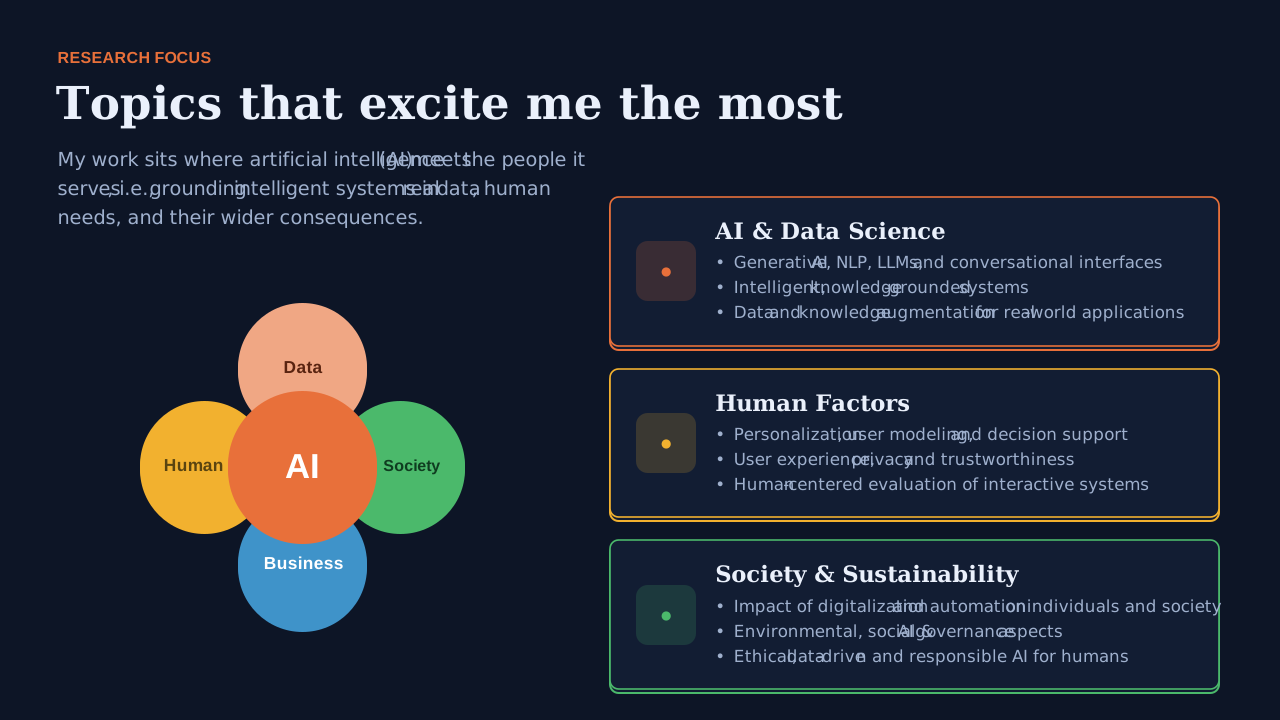
Currently, I work at TU Wien, Austria, within the Research Unit of Integral Building Technology, where I investigate AI-driven energy optimization and fault diagnosis domain for HVAC systems in smart buildings/cities. Using Generative AI tech stack, I investigate how conversatioanl assistants can alleviate part of the burden of an operating engineer in HVAC fault detection and diagnosis via natural langauge explanations. My primary research interests lie at the intersection of Recommender Systems, Conversational AI , Natural Language Processing (NLP), and Human-Computer Interaction.
From an early age, I was drawn to sciences. Choosing pre-engineering in high school felt like destiny. After a highly competitive entrance process; I was admitted to the BS Computer Science program in 2011 at a prestigious public engineering institute — University of Engineering and Technology (UET), Lahore.
During my BSc, I gained hands-on experience and began my career as a Software Developer (Intern) in 2014. My journey grew from solving problems in large codebases; exploring/debugging/coding tens of thousands of lines of code and hundreds of SQL tables. However, the curiosity to learn more led me to pursue a Master’s degree in Computer Science at Lahore University of Management Sciences (LUMS), focusing on data science and machine learning. Imagine, 10 years ago, implementing neural networks and machine learning models without modern libraries!:p
After completing my Master’s thesis in 2017, my curiosity to advance Data Science transformed into an R&D passion.
In 2019, I joined the University of Klagenfurt, Austria, as a Senior Scientist at the Institute of Artificial Intelligence and Cybersecurity (AICS). Within the Information Systems Research Group, I investigated natural language generation models (e.g., GPT, BERT, Transformers, RNNs, GNNs) and retrieval-based methods for the conversational recommendation problem, with a particular focus on their effectiveness in terms of quality and usability from a human-centric standpoint.
In 2023, this work led to my PhD dissertation . In essence, it was a transformative journey, where in addition to the persuit of becoming an independent researcher, and experiencing teaching at university, I explored how humans interact with multi-turn conversational agents for example, today's ChatGPT; and how technology can feel more natural, predictable, and human-intuitive.
Over the past decade, I have been fortunate to work across research labs, startups, and global enterprises in domains including travel and insurance, media, auto finance, e-commerce, and enterprise digital and data platforms. From gaining scientific exposure to solving practical problems, I see myself as a scientific liaison between R&D, engineering, and design, eager to apply the expertise I have developed over the years at a broader practical scale, while continuing to learn, build expertise, and create meaningful impact.
Outside of work, I enjoy sightseeing, traveling, and exploring multi-cuisine food, in addition to trying out the best coffee in the town☕. Have something serious to discuss? do not hestitate to reach out.
Projects
Knowledge-Grounded LLM Explanations for Zero-Shot HVAC Fault Diagnosis
Addresses the challenge of HVAC fault underdiagnosis in Building Management Systems (BMS) caused by fragmented sensor data and limited interpretability for engineers. The work introduces BMS-SEM-RAG, a zero-shot, topology-aware framework...
Hover for details →Knowledge-Grounded LLM Explanations for Zero-Shot HVAC Fault Diagnosis
OverviewAddresses the challenge of HVAC fault underdiagnosis in Building Management Systems (BMS) caused by fragmented sensor data and limited interpretability for engineers. The work introduces BMS-SEM-RAG, a zero-shot, topology-aware framework that integrates building information models (BIM) and domain knowledge into a unified knowledge graph for structured fault reasoning and explanation generation using LLMs. Evaluations across multiple LLMs and HVAC datasets show that topology-aware semantic grounding significantly improves diagnostic accuracy and reduces hallucinations. The study further highlights model-dependent trade-offs between accuracy, latency, and reasoning depth, demonstrating the value of knowledge-grounded LLMs for reliable HVAC fault diagnosis.
LLMs and Conversational Recommendation: User Perception of Response Quality
Investigates how users perceive the quality of large language model-based conversational recommender systems, with a focus on ChatGPT in movie recommendation scenarios. Through an online user study with 190 participants,...
Hover for details →LLMs and Conversational Recommendation: User Perception of Response Quality
OverviewInvestigates how users perceive the quality of large language model-based conversational recommender systems, with a focus on ChatGPT in movie recommendation scenarios. Through an online user study with 190 participants, the work compares ChatGPT against a strong retrieval-based conversational baseline. Results show that ChatGPT is generally perceived as more meaningful, particularly for direct recommendation tasks, but exhibits limitations in maintaining contextual consistency in longer dialogues. Further analysis reveals that information adequacy and recommendation accuracy are the strongest drivers of perceived quality, while correlations with traditional automatic metrics such as BLEU and ROUGE are weak, highlighting the need for human-centered evaluation in CRS.
- ChatGPT as a Conversational Recommender System: A User-Centric Analysis. 32nd ACM Conference on User Modeling, Adaptation and Personalization (UMAP 2024), Cagliari, Sardinia, Italy (2024).
Bridging Editorial Expertise and Automated Recommendation in Public Service Media (PSM)
Explores how domain knowledge from editors and publishers can be integrated into automated streaming recommender systems to improve content diversity, transparency, and relevance. Focusing on the challenges faced by PSM...
Hover for details →Bridging Editorial Expertise and Automated Recommendation in Public Service Media (PSM)
OverviewExplores how domain knowledge from editors and publishers can be integrated into automated streaming recommender systems to improve content diversity, transparency, and relevance. Focusing on the challenges faced by PSM providers such as ARD under digital transformation, the work highlights the limitations of purely data-driven recommendation approaches in heterogeneous content environments. To address this gap, the study introduces the ARD-M dataset, incorporating user interactions, metadata, and editorial signals. Empirical analyses demonstrate how different knowledge sources (e.g., editorial, publisher, and external metadata) influence diversity outcomes, providing a foundation for aligning human editorial expertise with AI-driven recommendation systems.
- Effects of Human-curated Content on Diversity in PSM: ARD-M Dataset. 1st Workshop on Learning and Evaluating Recommendations with Impressions (LERI), in conjunction with ACM RecSys 2023, Singapore (2023).
Designing New Evaluation Metrics for Interactive Systems
Studies the gap between offline evaluation metrics and human perception in conversational recommendation. While CRS research predominantly relies on computational measures, this work highlights their limited correlation with subjective user...
Hover for details →Designing New Evaluation Metrics for Interactive Systems
OverviewStudies the gap between offline evaluation metrics and human perception in conversational recommendation. While CRS research predominantly relies on computational measures, this work highlights their limited correlation with subjective user judgments such as meaningfulness. Through a within-subject user study (N=90), the project analyzes how user-related, system-related, and context-related factors influence perceived response quality. Results show that domain knowledge and response informativeness significantly improve perceived meaningfulness, while user experience with chatbots and age introduce systematic differences in expectations and satisfaction. The findings emphasize the need for user-centric formalization of CRS evaluation beyond offline metrics.
- INFACT: An Online Human Evaluation Framework for Conversational Recommendation. 4th Workshop of Knowledge-aware and Conversational Recommender Systems (KaRS), colocated with RecSys '22 (2022).
- Factors Influencing the Perceived Meaningfulness of System Responses in Conversational Recommendation. IntRS'23: Joint Workshop on Interfaces and Human Decision Making for Recommender Systems, Singapore (2023).
Impact of High-Quality Data Annotations on Knowledge-Aware Conversational Recommender Systems
Investigates how annotation quality influences the performance of end-to-end and retrieval-based conversational recommender systems. The project introduced INSPIRED2, a manually corrected version of the widely used INSPIRED dataset, addressing missing...
Hover for details →Impact of High-Quality Data Annotations on Knowledge-Aware Conversational Recommender Systems
OverviewInvestigates how annotation quality influences the performance of end-to-end and retrieval-based conversational recommender systems. The project introduced INSPIRED2, a manually corrected version of the widely used INSPIRED dataset, addressing missing and erroneous item and entity annotations. Extensive experiments demonstrated that improved annotation quality consistently enhances recommendation accuracy and response quality across multiple benchmark CRS models. The publicly released dataset provides a reliable benchmark for future research and underscores the critical role of high-quality annotated data in developing robust knowledge-aware conversational recommendation systems.
- INSPIRED2: An Improved Dataset for Sociable Conversational Recommendation. 4th Workshop of Knowledge-aware and Conversational Recommender Systems (KaRS), colocated with RecSys '22 (2022).
Language Generation vs. Retrieval in Conversational Recommender Systems
Investigates the comparative effectiveness of generation-based and retrieval-based approaches for conversational recommendation. While modern CRS predominantly rely on end-to-end neural language generation models trained on dialogue data, this work re-examines...
Hover for details →Language Generation vs. Retrieval in Conversational Recommender Systems
OverviewInvestigates the comparative effectiveness of generation-based and retrieval-based approaches for conversational recommendation. While modern CRS predominantly rely on end-to-end neural language generation models trained on dialogue data, this work re-examines retrieval-based methods that select and adapt responses from historical conversations. Through multiple user studies, the research shows that retrieval-based systems can match or outperform state-of-the-art generation models in perceived response quality. The findings highlight limitations of current neural generation approaches and suggest that retrieval-based techniques remain a strong alternative or complementary strategy in CRS design.
- Manzoor, A., & Jannach, D. (2021). Generation-based vs. retrieval-based conversational recommendation: A user-centric comparison. In Proceedings of the 15th ACM Conference on Recommender Systems (pp. 515–520).
- Manzoor, A., & Jannach, D. (2022). Revisiting Retrieval-based Approaches for Conversational Recommender Systems. In IIR.
- Manzoor, A., & Jannach, D. (2022). Towards Retrieval-based Conversational Recommendation. Information Systems, 109, 102083.
Conversational Recommender Systems (CRS): From Historical Foundations to Transformer Architectures
Investigates the evolution of conversational recommendation from knowledge-engineered systems to modern neural and transformer-based approaches. The project provides a comprehensive survey of CRS methodologies, interaction paradigms, and evaluation strategies while...
Hover for details →Conversational Recommender Systems (CRS): From Historical Foundations to Transformer Architectures
OverviewInvestigates the evolution of conversational recommendation from knowledge-engineered systems to modern neural and transformer-based approaches. The project provides a comprehensive survey of CRS methodologies, interaction paradigms, and evaluation strategies while critically examining the practical usability of state-of-the-art end-to-end conversational models. Through large-scale human evaluations, the research revealed substantial limitations in current neural CRS, demonstrating that many generated responses lack contextual relevance and that existing evaluation protocols often overestimate model quality. The findings highlight the need for more reliable evaluation methodologies and trustworthy conversational recommendation systems.
- Jannach, D., Manzoor, A., Cai, W., & Chen, L. (2021). A survey on conversational recommender systems. ACM Computing Surveys (CSUR), 54(5), 1–36.
- End-to-End Learning for Conversational Recommendation: A Long Way to Go? IntRS Workshop at ACM RecSys '20 (2020).
- Conversational recommendation based on end-to-end learning: How far are we? Computers in Human Behavior Reports, Volume 4, Pages 9 (2021).
ALAP: Accessible LaTeX-based Authoring and Presentation for Persons with Vision Impairment
ALAP is an accessibility-enhanced extension of the TeXlipse plugin for Eclipse, designed to enable inclusive LaTeX authoring for individuals with visual impairments. As the project lead, I directed the design...
Hover for details →ALAP: Accessible LaTeX-based Authoring and Presentation for Persons with Vision Impairment
OverviewALAP is an accessibility-enhanced extension of the TeXlipse plugin for Eclipse, designed to enable inclusive LaTeX authoring for individuals with visual impairments. As the project lead, I directed the design and development of accessible editing, navigation, debugging, and document-presentation features, integrating real-time auditory feedback through text-to-speech (TTS). The system provides accessible mathematical editing, PDF interaction, keyboard-centric workflows, and assistive menu navigation, allowing users to efficiently create, edit, and present technical documents while significantly improving usability and independence in scientific writing.
- Manzoor, A., Parvez, M., Shahid, S., & Karim, A. (2018). Assistive Debugging to Support Accessible LaTeX Based Document Authoring. In Proceedings of the 20th International ACM SIGACCESS Conference on Computers and Accessibility (pp. 432–434).
- Manzoor, A., Arooj, S., Zulfiqar, S., Parvez, M., Shahid, S., & Karim, A. (2019). ALAP: Accessible LaTeX Based Mathematical Document Authoring and Presentation. In Proceedings of the 2019 CHI Conference on Human Factors in Computing Systems (pp. 1–12).
Teaching
Continuing Education Programme for Early Career Researchers
Professional Development Programme, University of Klagenfurt · 2023 · Klagenfurt, Austria
Participant (79 hours).
Data Structures and Algorithms
Undergraduate course, University of Klagenfurt · 2021 · Klagenfurt, Austria
Course instructor, co-ordinator.
Introduction to Computer Science
Undergraduate course, University of Klagenfurt · 2020-2023 · Klagenfurt, Austria
Instructor, course organizer, coordinator.
Software Reuse
Graduate course, Department of Computer Science, LUMS · 2017 · Lahore, Pakistan
Teaching Assistant.
Software Project Management
Graduate course, Department of Computer Science, LUMS · 2017 · Lahore, Pakistan
Teaching Assistant.
Services
Invited Reviewer
- Journal of Intelligent Information Systems (JIIS), 2026
- Transactions on Intelligent Systems and Technology, 2026
- Journal of Entropy, MDPI, 2024, 2025, 2026
- Journal of Evolving Systems (EVOS), Springer, Nature, 2024, 2025, 2026
- ACM Transactions on Recommender Systems (TORS), 2023
- Journal of Human-computer Interaction (HCI), 2023
- Journal of User Modeling and User-Adapted Interaction (UMUAI), 2023
- International Conference on Intelligent User Interfaces (IUI ‘23), 2023
- Conference on Human Factors in Computing Systems (CHI ‘23), 2023
- Journal of Natural Language Engineering, 2022
- Journal of Artificial Intelligence Review, 2022
Program Committee Member
- Program committee member for CIKM ‘26, Rome, Italy (2026)
- Program committee member at 2ICML’22 (International Conference on Intelligent Computing and Machine Learning) held in Qingdao, China, from the 16th to 18th of December 2022. (2022)
Conference Organization
- SV at ACM Conference on Recommender Systems (RecSys 2026) (to be held) (2026)
- Co-leader for CHI Global Plaza sessions at CHI ‘23 (2023)
- SV at 16th ACM Conference on Recommender Systems Seattle, WA, USA, 18th-23rd September 2022. (2022)
- Organizing Committee Member, International Conference on Open Source Systems & Technologies (ICOSST 2013) (2013)
Mentoring & Student Collaboration
- 2 students — University of Klagenfurt (6 months)
- 2 students — University of Klagenfurt (1 month)
- 2 students / MSc thesis — Lahore University of Management Sciences (LUMS) (1 year)
- 1 student / MSc thesis — University of Applied Sciences Bonn, Germany (1 year)
- 1 collaboration with doctoral thesis student — Mainz University of Applied Sciences, Germany
Professional Recognition
- 2024 Best Paper nominee mention at UMAP '24
- 2019 Best Researcher Award by HEC Pakistan for delivering an open-source software for visually impaired people
- 2015 NETSOL Soldier Award for showing the best discipline in trainings
- 2015–2017 Selected for the LUMS Financial Support Program for MSc studies
- 2012 Selected as a top student for the Youth Development Internship (YDC) program by the Chief Minister's Office, Punjab, Pakistan
- 2011–2015 PEEF Scholarship for BSc studies, awarded for being a top performer in high-school studies
Talks
- Building a Successful Career in Europe — LUMS CSO, Online (2026)
- Factors Influencing the Perceived Meaningfulness of System Responses in Conversational Recommendation — IntRS’23: Joint Workshop on Interfaces and Human Decision Making for Recommender Systems, September 18, 2023, Singapore., Austria (remote) (2023)
- Advances in Conversational Recommendation — Doctoral Defense, University of Klagenfurt, Austria (2023)
- INSPIRED2: An Improved Dataset for Sociable Conversational Recommendation — 4th Workshop of Knowledge-aware and Conversational Recommender Systems (KaRS '22), Seattle, USA (2022)
- INFACT: An Online Human Evaluation Framework for Conversational Recommendation — 4th Workshop of Knowledge-aware and Conversational Recommender Systems (KaRS '22), Seattle, USA (2022)
- Revisiting Retrieval-based Approaches for Conversational Recommender Systems — 12th Italian Information Retrieval Workshop (IIR '22), Milan, Italy (2022)
- Generation-based vs. Retrieval-based Conversational Recommendation: A User-Centric Comparison — 15th ACM Conference on Recommender Systems (RecSys '21), Amsterdam, Netherland (2021)
- End-to-End Learning for Conversational Recommendation: A Long Way to Go? — IntRS Workshop colocated with RecSys 2020, IntRS, Online (2020)
- Assistive Debugging to Support Accessible Latex Based Document Authoring — Lahore University of Management Sciences, Lahore, Pakistan (2017)
Publications
You can also find my articles on my Google Scholar profile.
From BIM to Bedside Manner: Explainable, Knowledge-Grounded LLM-based Q&A for Zero-Shot HVAC Fault Diagnosis
Under review at the 20th ACM International Conference on Web Search and Data Mining (WSDM 2027)
ChatGPT as a Conversational Recommender System: A User-Centric Analysis
Published in In Proceedings of the The 32nd ACM Conference on User Modeling, Adaptation and Personalization. Monday 1 - Thursday 4 July, 2024. Cagliari, Sardinia, Italy, 2024
Factors Influencing the Perceived Meaningfulness of System Responses in Conversational Recommendation
Published in IntRS’23: Joint Workshop on Interfaces and Human Decision Making for Recommender Systems, September 18, 2023, Singapore (hybrid event)., 2023
Effects of Human-curated Content on Diversity in PSM:ARD-M Dataset
Published in 1st Workshop on Learning and Evaluating Recommendations with Impressions (LERI) held in conjunction with the ACM International Conference on Recommender Systems (RecSys 2023) in Singapore, September 18-23, 2023, 2023
INSPIRED2: An Improved Dataset for Sociable Conversational Recommendation
Published in 4th Workshop of Knowledge-aware and Conversational Recommender Systems (KaRS), colocated with RecSys '22, 2022
Revisiting Retrieval-based Approaches for Conversational Recommender Systems
Published in 12th Italian Information Retrieval Workshop (IIR '22), 2022
Towards Retrieval-based Conversational Recommendation
Published in Information Systems, Volume 109, Pages 14, 2022
INFACT: An Online Human Evaluation Framework for Conversational Recommendation
Published in 4th Workshop of Knowledge-aware and Conversational Recommender Systems (KaRS), colocated with RecSys '22, 2022
Generation-based vs. Retrieval-based Conversational Recommendation: A User-Centric Comparison
Published in 15th ACM Conference on Recommender Systems (RecSys '21), 2021
Conversational recommendation based on end-to-end learning: How far are we?
Published in Computers in Human Behavior Reports, Volume 4, Pages 9, 2021
A Survey on Conversational Recommender Systems
Published in ACM Computing Surveys (CSUR), Volume 54, Article No.: 105, pp 1–36, 2021
End-to-End Learning for Conversational Recommendation: A Long Way to Go?
Published in IntRS Workshop at ACM RecSys '20, 2020
ALAP: Accessible LaTeX Based Mathematical Document Authoring and Presentation
Published in Proceedings of the 2019 CHI Conference on Human Factors in Computing Systems (CHI '19), 2019
Assistive Debugging to Support Accessible Latex Based Document Authoring
Published in the 19th International ACM SIGACCESS Conference on Computers and Accessibility (ASSETS '18), 2018